
This photograph of Dresden, taken in
1946, shows the view from City Hall
out over the devastated city. In the
foreground is an unscathed sculpture
atop the City Hall tower.
1946, shows the view from City Hall
out over the devastated city. In the
foreground is an unscathed sculpture
atop the City Hall tower.
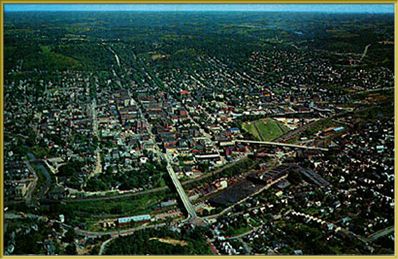
| Aerial view of Butler |
The Butler Pennsylvania Poems
The Bombing of Butler
The planes would come in
from the West
at an angle, so as to run
up along the valley
to destroy our mills,
then lay a carpet of bombs
one mile wide
straight up across our town,
fixing on the Court House
then out to the hill beyond
where the hospital stands
then further still
to our railroad yards
and the bridge across.
Twenty merciless runs they'd make
and whatever still stood
would be ground
in drafts of fire—
Dresden
burnt into memory
murmuring:
Try to imagine.
And those who survived
would gather along the creek
where water soothed
or in our woods
under protecting wings
while one long dirge of soft wailing
would be heard
for what had been.
Then one among them would rise,
agéd now and enlightened,
with that one word empowered:
Build—
And it would happen.
Next Home
Comment
The Bombing of Butler
The planes would come in
from the West
at an angle, so as to run
up along the valley
to destroy our mills,
then lay a carpet of bombs
one mile wide
straight up across our town,
fixing on the Court House
then out to the hill beyond
where the hospital stands
then further still
to our railroad yards
and the bridge across.
Twenty merciless runs they'd make
and whatever still stood
would be ground
in drafts of fire—
Dresden
burnt into memory
murmuring:
Try to imagine.
And those who survived
would gather along the creek
where water soothed
or in our woods
under protecting wings
while one long dirge of soft wailing
would be heard
for what had been.
Then one among them would rise,
agéd now and enlightened,
with that one word empowered:
Build—
And it would happen.
Next Home
Comment
Author's Note
The author visited Dresden shortly after the reunification of East and West Germany in 1989.
On arriving he mounted the high Rathaus tower to have a panoramic view of the city and the
surroundings. Looking out to the west he could almost hear the waves of bombers approaching
the city. Overhead they would have dropped their bombs into the area he was looking at, then
curve off to the left and vanish in the western sky leaving the city in flames and ruins.
The thought occurred to him that this could some day happen to cities at home, even though it
is hard for Americans to conjure up that possibility, the country being protected by two oceans
and great distances from potential aggressors. However, the need to think that thought was the
impulse that brought this poem about.
The author visited Dresden shortly after the reunification of East and West Germany in 1989.
On arriving he mounted the high Rathaus tower to have a panoramic view of the city and the
surroundings. Looking out to the west he could almost hear the waves of bombers approaching
the city. Overhead they would have dropped their bombs into the area he was looking at, then
curve off to the left and vanish in the western sky leaving the city in flames and ruins.
The thought occurred to him that this could some day happen to cities at home, even though it
is hard for Americans to conjure up that possibility, the country being protected by two oceans
and great distances from potential aggressors. However, the need to think that thought was the
impulse that brought this poem about.
- May, 1991